

Between 2020 and 2024, India added roughly 80 million new demat accounts. These are not sophisticated investors. They are first-generation market participants — salaried professionals in Tier 1 and Tier 2 cities, small business owners, young earners investing their first surplus income.
They downloaded Groww or Zerodha, figured out how to start a SIP, and began their investing journey. And then they were largely left alone — no AI wealth guidance India could offer them, no personalised advice, no real financial planning.
The gap between access to financial products and access to financial guidance is the defining problem of India’s wealth management industry. AI wealth guidance India needs is not a luxury feature. It is the only solution that works at the scale of 200 million underserved investors.
“India has approximately 125 million demat account holders. It has fewer than 1,000 SEBI-registered investment advisors. That is one qualified advisor for every 125,000 investors. The math simply does not work without AI.”

India's advisory gap in a single number: 125,000 investors per qualified advisor. No amount of human hiring can close this gap. Only AI wealth guidance at scale can.
The advisory gap — why it exists
India has approximately 125 million demat account holders. It has fewer than 1,000 SEBI-registered investment advisors (RIAs) — advisors who are legally authorised to give personalised financial advice for a fee.
Do the math: that is one qualified advisor for every 125,000 investors.
The alternative — commission-based distributors — exists in far greater numbers. But their incentives are structurally misaligned with their clients. A distributor earns more when they sell you a product with higher commission, regardless of whether it is the right product for your situation. This is not a criticism of individuals. It is a structural problem.
The existing advisory infrastructure was built for HNIs — people with ₹1 crore or more to invest, where the advisory fee or trail commission is large enough to make the relationship economically viable. For the person with ₹15,000 to invest every month, that infrastructure does not work. They need AI wealth guidance India can deliver at scale — and that is exactly what is missing.
What first-generation investors actually struggle with
We spent considerable time understanding what India’s emerging investor actually needs. The problems are remarkably consistent across income levels and geographies:
They do not know if their current investments are aligned with their goals. Most people start SIPs because someone told them SIPs are good. They do not know if the fund they chose is appropriate for their timeline, their tax situation, or their risk tolerance. Without AI wealth guidance India’s investors are essentially guessing.
They do not know how much to invest. There is a massive difference between investing what is left over after expenses and investing what is actually needed to meet specific goals. Very few first-time investors have done this calculation — because no one has helped them do it.
They do not understand their complete financial picture. Most people have investments scattered across multiple platforms, insurance policies they barely remember, EPF balances they have not checked in years, and bank accounts with idle cash earning 3%. No one has ever shown them how it all fits together.
They do not know when to change something. Markets move. Life changes. SIPs that made sense two years ago may not make sense today. A baby, a job change, a home purchase — each of these should trigger a portfolio review. Without ongoing guidance, most investors either ignore their portfolio entirely or make reactive decisions at exactly the wrong time.


Left: A first-generation investor who started a SIP but has no idea if it aligns with their goals. Right: An Indian family with 3 financial goals but no advisor to help prioritise and plan — exactly the gap AI wealth guidance India needs to fill.
Why human advisors cannot solve this at scale
The instinctive answer to “investors need guidance” is “hire more advisors.” But the unit economics make this impossible at scale.
A fee-only SEBI-registered advisor typically charges ₹10,000–₹50,000 per year for comprehensive financial planning. For someone investing ₹15,000 per month (₹1.8 lakh per year), paying ₹25,000 for an advisor fee is 14% of their entire annual investment — economically irrational.
Commission-based advisors solve this by earning from product manufacturers instead. But this creates the incentive misalignment described above — the advisor is paid by the fund house, not by you, so their recommendations serve the fund house’s interests first.
There is no sustainable business model for human advisors serving India’s ₹15,000/month investor. The per-user cost is too high, the revenue per user is too low, and the complexity of Indian financial products (different tax treatments for ELSS vs debt vs equity, NPS tax benefits, 80C limits, HRA calculations) means generic advice is genuinely harmful.
AI wealth guidance India needs is the only model where the unit economics work at this scale. The marginal cost of serving one more user with AI is nearly zero. The quality of advice improves with scale, not degrades. And the AI never has a commission incentive.
Why AI changes the equation — fundamentally
An AI system with access to a user’s complete financial data — through Account Aggregator — can do in seconds what would take a human advisor an hour:
— See the complete picture: all bank accounts, all investments, all loans, all insurance, EPF, NPS — everything, verified, in one place
— Run the scenarios: what happens if you increase your SIP by ₹5,000? What if you switch from regular to direct plans? What if interest rates rise 50bps?
— Identify the gaps: you have no term insurance despite having dependents. Your emergency fund covers only 2 months, not 6. Your 80C limit is underutilised by ₹42,000
— Explain its recommendations in plain language — not jargon, not disclaimers, not generic advice. Specific numbers. Specific actions. Specific reasons.
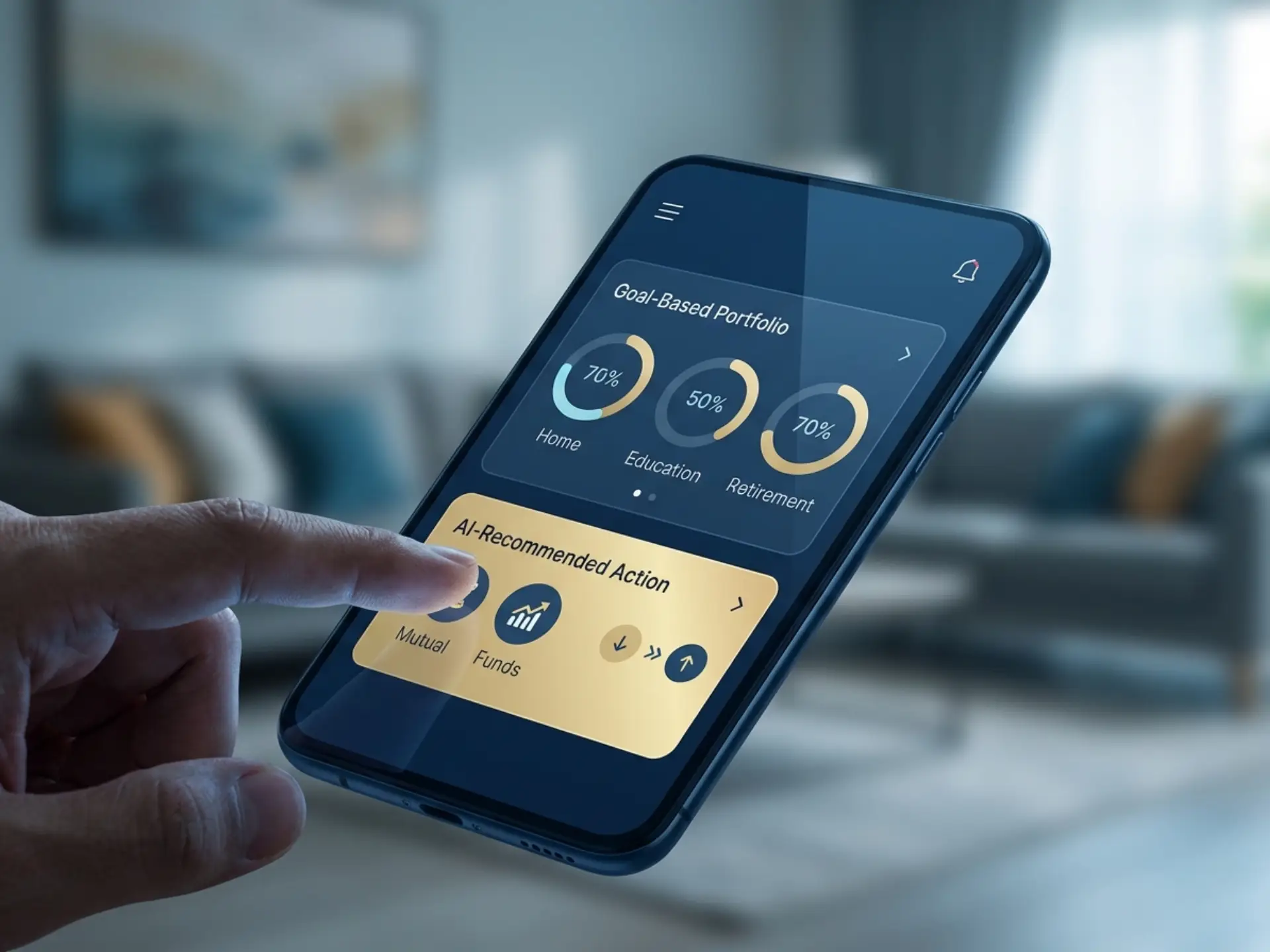
Without AI: "Invest in equity for long-term goals." With AI wealth guidance powered by Account Aggregator data: "Based on your ₹1.12L salary, ₹31K home loan EMI, and ₹50L education goal in 14 years — here are 3 specific changes with the tax impact of each."
This is not a replacement for human advisors in complex situations — HNIs with ₹5 crore portfolios, business owners with intricate tax structures, people going through estate planning. Those situations require human judgment, empathy, and regulatory interpretation that AI cannot reliably provide today.
But for the 200 million Indians who currently have zero access to any guidance whatsoever — AI wealth guidance India can deliver is not a second-best option. It is the only option that scales.
What Nivyo.AI is building for India’s underserved investors
Nivyo.AI is built specifically for this user — the first-generation investor who has started their investing journey but has never had access to the guidance that would make it effective.
Using Account Aggregator data, Nivyo.AI builds a complete picture of your financial life in under 60 seconds. Using AI, it identifies what is working, what is not, and what needs to change. And it explains everything in plain language — no jargon, no financial acronyms without explanation, no assumption that you already know what a Sharpe ratio is.
It does not need you to be financially sophisticated to use it. That is the point. The entire product is designed for someone who has never had an advisor, never understood their complete financial picture, and never received a recommendation that was actually based on their specific situation.
India’s 200 million new investors deserve the same quality of AI wealth guidance India’s top 1% have always had access to — just delivered by AI instead of expensive humans, at a fraction of the cost, with zero commission incentive.
That is what Nivyo.AI delivers. And that is why we are building it.